The air in Varanasi—ancient Kashi—is thick with the scent of burning sandalwood, the rhythmic tolling of temple bells, and the eternal smoke of the Manikarnika pyres. To the uninitiated, it is a city of chaos; to the seeker, it is a Maha-Smashana, the "Great Crematorium" where the physical world meets the cosmic ocean.
For millennia, Kashi has not just been a city, but a spiritual gateway. As a Senior Strategist and Vedic Scholar, I invite you to explore why this specific geography is considered the "Navel of the Universe" and why a ritual performed here carries a potency found nowhere else on Earth.
The Cosmic Anatomy: Why Kashi is Not on Earth
According to the Kashi Khanda of the Skanda Purana, Kashi does not rest upon the terrestrial ground. It is said to be perched upon the Trishula (Trident) of Lord Shiva himself.
“Kashyam hi maranan muktih” (Death in Kashi is Liberation itself.)
This isn't mere poetic license. In Vedic metaphysics, Kashi is a Tirtha—a "crossing place" or a bridge. The city’s geography is aligned with the subtle energy channels of the human body (Nadis). The confluence of the Varuna and Assi rivers with the Ganga creates a sacred circuit that mirrors the Ida, Pingala, and Sushumna currents, making it the ultimate destination for Moksha (liberation from the cycle of rebirth).
The North-Flowing Ganga (Uttarvahini)
In most of India, the Ganges flows Southeast. However, in Kashi, the river miraculously turns back toward its source in the North. This Uttarvahini flow represents the reversal of the cycle of life—moving from the mundane back to the Divine. When you perform a Sankalpa or Tarpana here, the water carries your intentions "upstream" toward the source of all consciousness.
The "Why": Addressing the Soul’s Debt (Pitri Rin)
Many devotees come to us feeling a sense of restlessness or "blockage" in their lives—unexplained hurdles in career, health, or family harmony. In the Vedic tradition, this is often identified as Pitri Dosha.
We exist because of our ancestors. Our DNA is their gift; our struggles are often their unresolved karmas. Ignoring the rites of our lineage (Pitri Karya) is akin to cutting the roots of a tree and expecting the fruit to grow. Kashi is the specific "remedy center" of the world where these ancestral debts are settled.
What happens if these rituals are ignored?
The Garuda Purana suggests that souls trapped in Preta Yoni (a state of limbo) seek sustenance through the vibrations of their living descendants. When we offer Pind Daan in Kashi, we aren't just feeding a memory; we are providing the metaphysical fuel required for the soul to transition into the realm of the Pitrus (Ancestors).
The Science of the Ritual: Beyond the Symbolic
To the modern mind, using Kusha grass, Black Sesame, and Rice balls (Pinds) might seem like folklore. However, there is a profound metaphysical science at play:
- Kusha Grass (Desmostachya bipinnata): Vedic texts identify Kusha as a natural conductor of spiritual energy. It acts as a "sacred antenna" during a ritual, stabilizing the aura of the performer.
- Black Sesame (Til): Sesame seeds are high-energy carriers. In Tarpana, they are used to attract and absorb the subtle vibrations of the departed, acting as a medium for the water offering.
- The Pind: The circular shape represents the universe and the completion of the cycle. By offering the Pind at the feet of Lord Vishwanath, the performer surrenders the ancestor's ego back to the elements.
The Ritual Process: A Step-by-Step Vidhi in Kashi
When you organize a ritual through SacredKashi, the process follows the strict Dharma Sindhu protocols:
- Snana (Purification): The ritual begins with a dip in the holy Ganga to purify the Sthula Sharira (physical body).
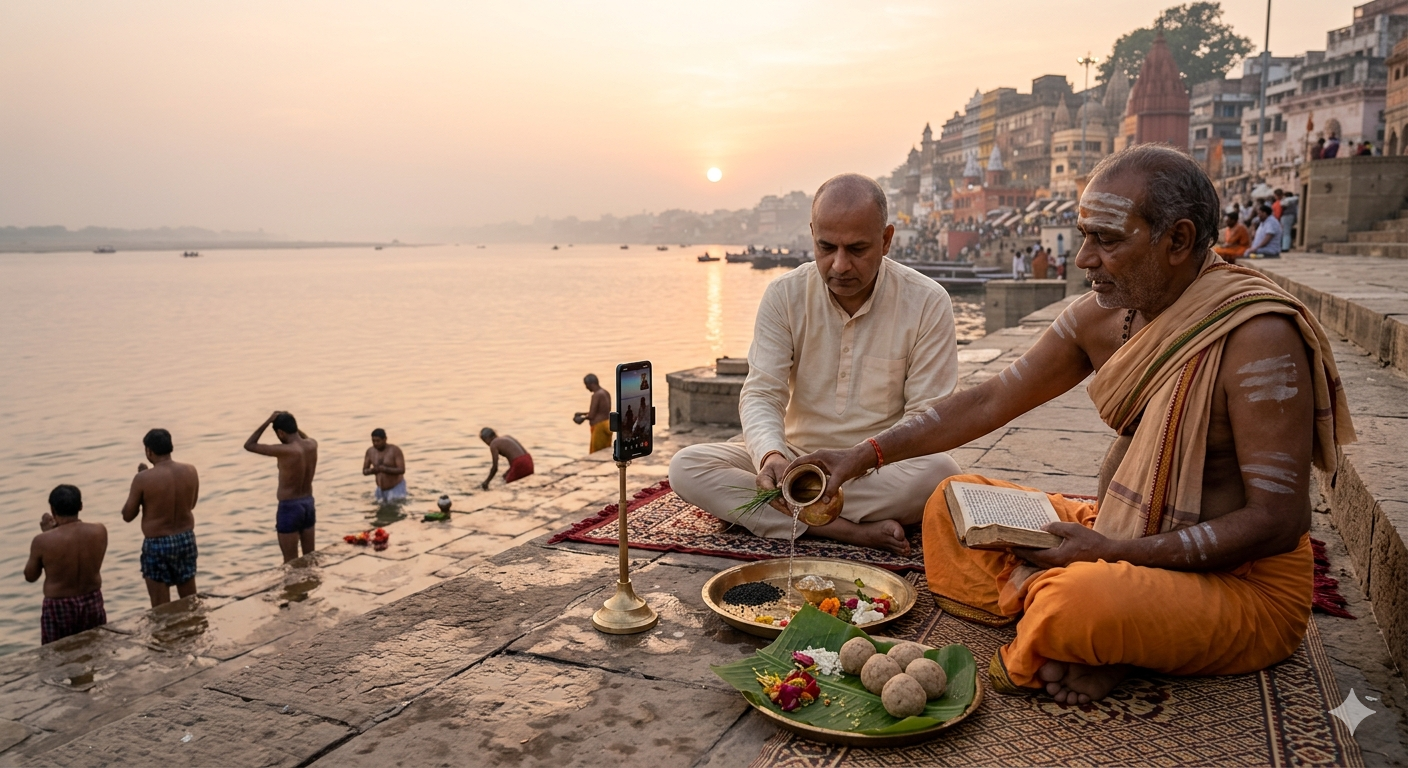
- Sankalpa: The most crucial step. The Acharya helps you state your name, lineage (Gotra), and intent. Even for NRIs via Remote Sankalpa, your name is vibrated into the atmosphere of Kashi at the exact moment of the ritual.
- Tarpanam: Water, milk, and sesame are offered to please the Devas, Rishis, and Pitrus.
- Pind Daan: Offering of cooked rice and barley flour balls to provide a "body" for the soul's journey.
- Brahman Bhoj: Feeding the scholars of Kashi, which completes the cycle of charity (Dana).
Bridging the Gap: For the Global Diaspora
We understand the challenges of living in London, New York, or Sydney. You carry the weight of tradition but face the constraints of geography.
Remote Sankalpa & Video Technology
Can a ritual thousands of miles away be effective? The Vedas state that Manas (mind/intent) is faster than light. Our Remote Sankalpa service uses live video calls where you witness the Vedic Mantras being chanted in your name at the Manikarnika or Dashashwamedh Ghat. The vibrations of the Sanskrit Shlokas are not bound by distance; they are bound by the sincerity of the Sankalpa.
Logistics & Transparency
- English-Speaking Acharyas: No more language barriers. Our Pundits explain the meaning of every Shloka.
- International Prasad Delivery: We ship the Prasad and sacred Gangajal (Ganga water) to your doorstep, ensuring you receive the physical blessings of the ritual.
Frequently Asked Questions (FAQ)
1. Why is Kashi preferred over other cities for Pind Daan? Kashi is the Mokshapuri, where Lord Shiva imparts the Taraka Mantra to the dying. Rituals here are believed to provide ten times the spiritual merit (Punya) compared to other locations due to the city's unique cosmic alignment.
2. Can I perform rituals for my ancestors if I don't know my Gotra? Yes. In cases where the Gotra is unknown, the Kashyapa Gotra is used, as Vedic tradition considers Sage Kashyapa the progenitor of all humanity. Our Acharyas will guide you through this.
3. Is a ritual done via video call as effective as being there in person? The Sankalpa is a mental and verbal contract. As long as your intent is firm and the priest performs the physical acts in the high-vibration zone of Kashi, the spiritual benefit is fully transferred to your lineage.
4. What is the best time of year to perform ancestral rites in Kashi? While Kashi is holy year-round, the Pitru Paksha (the fortnight of the ancestors) is the most potent. However, performing rites on Amavasya (New Moon) or during an eclipse is also highly recommended.
5. How do I ensure the Pundits are authentic? SacredKashi only collaborates with hereditary Vedic scholars who have studied at traditional Pathshalas. We provide a profile of your lead Acharya before the ritual begins for complete transparency.