Living in the bustling hubs of London, New York, or Toronto, the distance from the sacred ghats of Varanasi can feel like more than just geographical. For the Global Indian diaspora, the greatest challenge isn't professional success; it is the "Cultural Gap." How do we ensure our children—raised in a digital, Western environment—stay rooted in the profound wisdom of their ancestors?
The answer lies not in textbooks, but in Anubhava (experience). At SacredKashi, we believe that the rituals performed in the holy city of Kashi are not just for the departed, but are vital educational anchors for the living. By involving the next generation in Vedic rituals, we transform abstract "religion" into a living, breathing heritage.
The "Cultural Hunger": Why Identity Matters for Diaspora Children
In the West, children often face a dual-identity crisis. Without a spiritual foundation, they may feel untethered. The Garuda Purana emphasizes that a lineage is like a tree; the children are the leaves, and the ancestors are the roots. If the roots are not nourished through Tarpana and Sanskara, the leaves eventually wither.
The pain point for many NRI parents is the fear of their children becoming "culturally orphaned." By introducing them to the science of Kashi rituals, you provide them with a "spiritual GPS" that guides them regardless of where they live.
Bridging the Gap: The Science of Ritual as an Educational Tool
To a child raised in the West, a ritual must make sense. It cannot just be "because I said so." Vedic rituals are deeply metaphysical and symbolic. When we explain the why, we engage their intellect.
The Metaphysics of the Ritual
- Kusha Grass: Explain to your children that Kusha grass is a natural conductor of spiritual energy, used in Vedic times much like a copper wire in modern physics.
- Black Sesame (Til): These represent the smallest units of life and the permanence of memory.
- The Pind (Rice Balls): These represent the physical body, reminding us that we are made of the same elements as our ancestors.
The Power of Sanskrit Sound
The vibration of Vedic chanting has been scientifically studied for its effects on neuroplasticity. When our English-speaking Acharyas chant the Mantra Pushpam, we encourage children to listen to the resonance.
“Om Sahanā Vavatu | Sahanau Bhunaktu | Sahavīryam Karavāvahai” (May we be protected together; may we be nourished together; may we work together with great energy.)
From the Ghats to the Screen: The Remote Sankalpa Experience
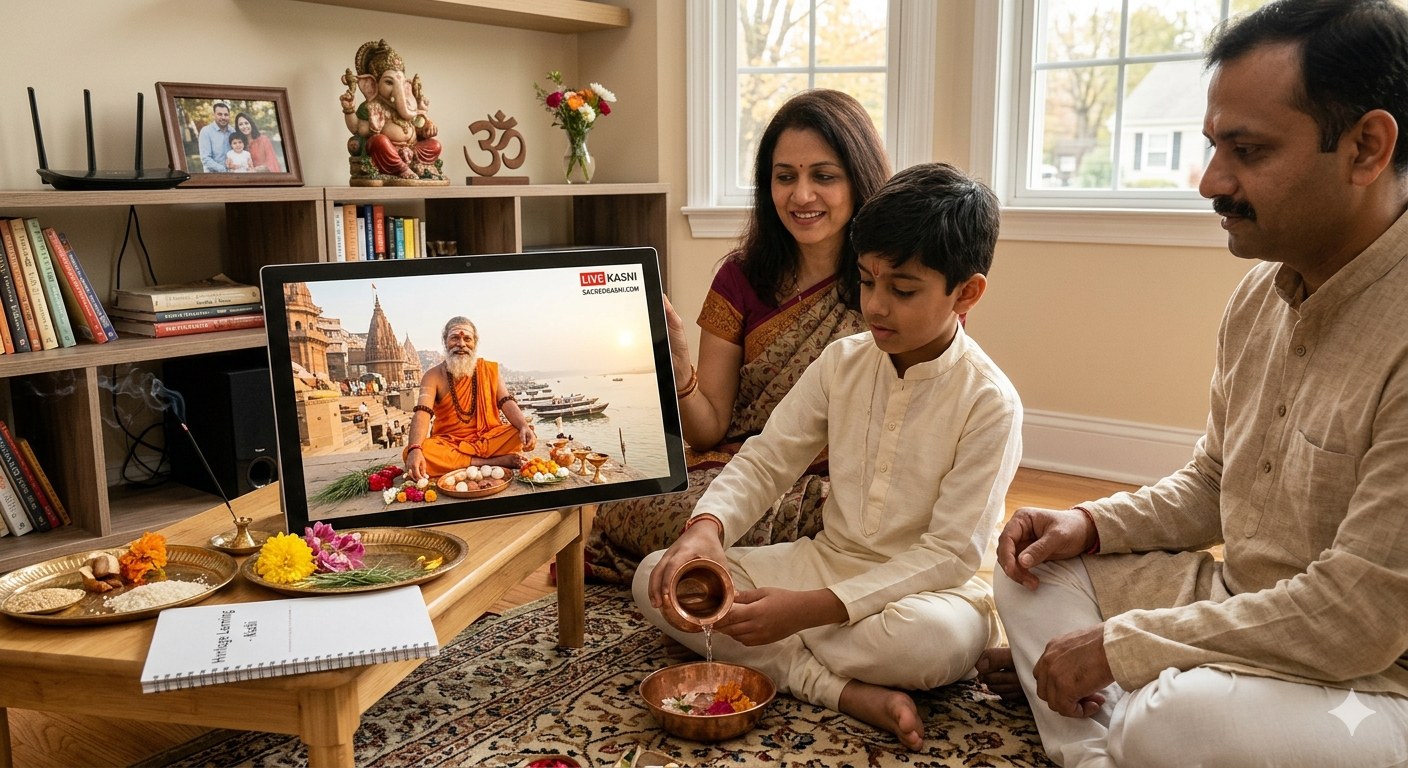
One of the most powerful ways to bridge the distance is through a Remote Sankalpa via Video Call. Imagine your child sitting in your living room in California, watching the sunrise over the Manikarnika Ghat in Kashi.
Our English-speaking pundits don't just perform the ritual; they narrate it. They explain the geography of the Pancha Kroshi Yatra and the history of the Kashi Vishwanath Temple. This real-time connection turns a ritual into a virtual pilgrimage.
Step-by-Step Heritage Learning through Ritual:
- Preparation: Involving the child in gathering flowers or water, teaching them about Shuddhi (purity).
- The Sankalpa: The child hears their name, Gothra, and lineage recited in the presence of the Ganga. This reinforces their place in a 5,000-year-old timeline.
- The Explanation: Our Acharyas take moments between mantras to explain the meaning in fluent English, ensuring the child isn't just a spectator but a participant.
The Role of the "English-Speaking Acharya"
In many traditional settings, the language barrier is the death of interest. A child who doesn't understand the Pundit will eventually tune out. At SacredKashi, our scholars are trained both in the Rig Veda and in modern communication. They speak the language of the youth—logical, empathetic, and clear.
By seeing a scholar who is deeply rooted in tradition yet understands the Western context, children find a role model. They realize that being "Vedic" and being "Modern" are not mutually exclusive.
Practical Ways to Integrate Kashi into Western Life
- Monthly Tarpana: Spend 10 minutes a month acknowledging ancestors. It teaches children gratitude (Kritagyata).
- Digital Darshan: Use our platform to witness the Ganga Aarti. The sensory details—the rhythmic bells, the smell of incense, the flickering lamps—create "spiritual memories."
- Prasad Delivery: We ship sanctified Prasad from Kashi to your doorstep globally. The physical act of receiving something from the "City of Light" makes the connection tangible for a child.
Frequently Asked Questions (FAQs)
How can I explain Pind Daan to a child raised in the West? Explain it as a "Thank You" ceremony. Just as we thank our parents for a gift, Pind Daan is a way to thank our ancestors for the gift of life and our DNA, ensuring their energy remains peaceful and supportive.
Do my children need to speak Sanskrit to participate? No. While the mantras are in Sanskrit for their vibrational quality, our English-speaking pundits provide full translations and context so children can understand the emotional and spiritual intent behind every action.
Is a ritual performed via video call as effective as being there? Yes. In Vedic science, Sankalpa (intention) transcends physical distance. The priest acts as a proxy (Pratinidhi) in the high-energy field of Kashi, while your family connects through intention and sound.
How does learning about rituals help with my child's identity? It provides "Cultural Literacy." When a child understands their roots, they develop a stronger sense of self and resilience, making them less likely to feel lost in the pressures of Western peer groups.
What is the best age to start involving children in Kashi rituals? There is no minimum age. Even infants benefit from the vibrations of Vedic chanting. However, ages 7 and up are ideal for interactive learning where they can begin to understand the symbols and stories.