The air in Varanasi—the ancient city of Kashi—carries a weight that transcends time. As the morning mist rises from the sacred Ganges (Ganga), the rhythmic clanging of temple bells mingles with the deep, guttural resonance of Vedic chants. For thousands of years, families have traveled to these ghats with a singular, heavy-hearted purpose: to ensure their departed loved ones find Moksha (liberation).
If you have felt an inexplicable heaviness in your life, or if your family faces recurring obstacles despite every effort, the Vedic scriptures suggest looking toward your roots. This isn’t just tradition; it is the metaphysical science of Pind Daan.
Understanding Pitru Dosha: The Unseen Spiritual Debt
In the Vedic tradition, our existence is not solitary. We are the sum of our ancestors’ choices, energy, and unresolved desires. When a soul departs without the completion of specific rites, it may remain in a state of unrest, leading to what the Dharma Sindhu identifies as Pitru Dosha.
Signs Your Lineage Requires Healing:
- Persistent financial instability despite hard work.
- Delayed marriages or disharmony within the home.
- Health issues that baffle modern medicine.
- A general sense of "stagnation" in life’s progress.
By performing Pind Daan at the Manikarnika or Dashashwamedh Ghat, you aren't just performing a ritual; you are settling a spiritual debt, offering the "nourishment" required for the soul to transition from the earthly plane to the realm of the ancestors (Pitru Loka).
The Scriptural Authority: Why Kashi?
Kashi is not merely a geographic location; it is the Mahashmashana—the Great Cremation Ground where Lord Shiva himself whispers the Taraka Mantra into the ears of the dying.
The Garuda Purana states:
“Gaya-shirshe Vate chaiva Akshayye pinda-dayakah | Pitaras-tulyam-asnanthi koti-kalpa-shatair-api ||”
Translation: "Offerings made at the holy sites like Kashi and Gaya provide satisfaction to ancestors that lasts for millions of ages."
While Gaya is vital for the Vishnupada, Kashi is where the liberation is finalized through the grace of Lord Vishwanath. Performing Shradh here breaks the cycle of rebirth, ensuring the soul does not wander in the "Preta" (ghostly) state.
The Metaphysical Science: Kusha, Til, and Pinds
To the untrained eye, Pind Daan looks like a simple offering of food. To a Vedic scholar, it is a complex manipulation of energy.
1. The Pind (Rice Balls)
The Pind is a symbolic representation of the physical body. Prepared with cooked rice or barley flour mixed with honey and milk, it acts as a "vessel" for the ancestor's energy to receive the offerings.
2. Black Sesame Seeds (Kala Til)
Sesame seeds are considered the "seeds of immortality." In the Rig Veda, they are used to ward off negative energies and act as a medium for the Pitrus to absorb the essence of the Tarpana.
3. Kusha Grass (Desmostachya bipinnata)
Kusha grass is a known conductor of spiritual energy. By wearing a ring (Pavitri) made of Kusha, the performer ensures that the high-frequency vibrations of the Mantras are grounded and directed toward the lineage.
Step-by-Step: The Process of Kashi Pind Daan
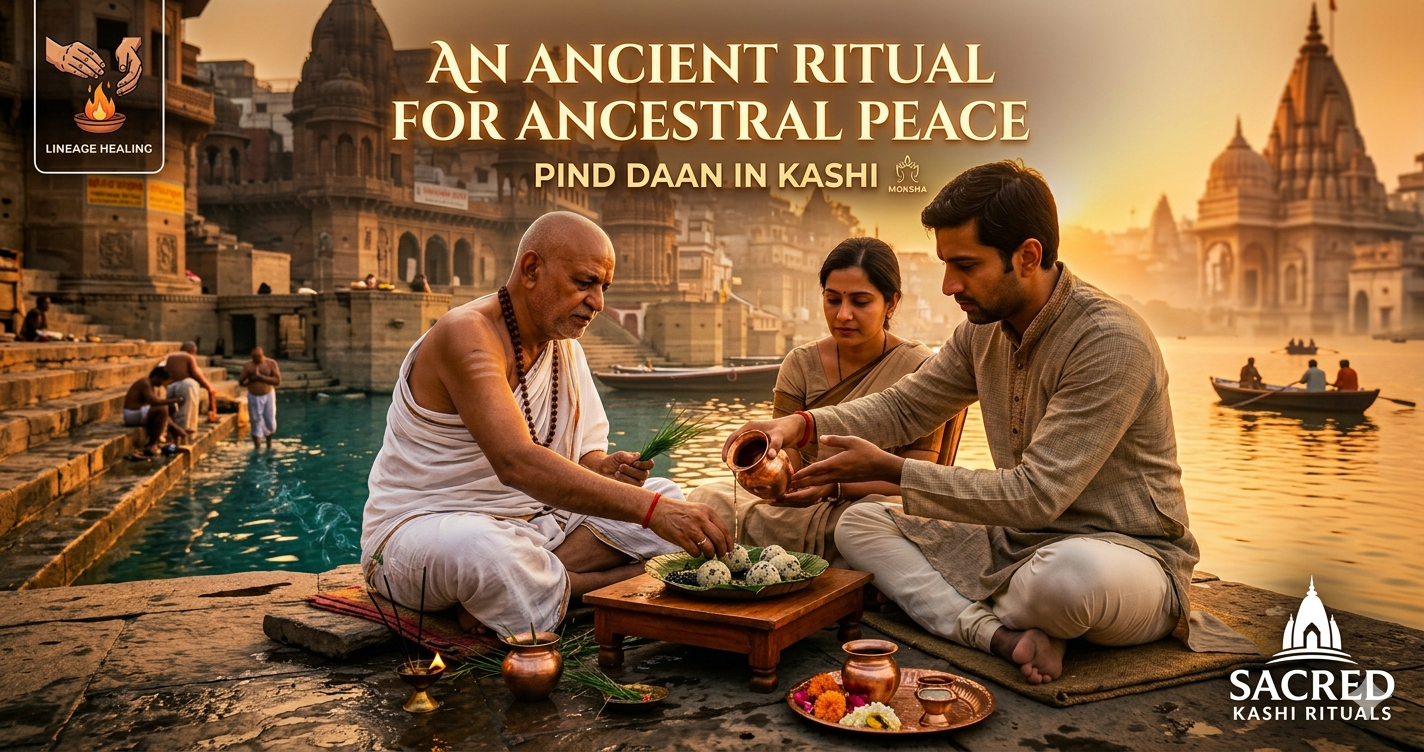
When you arrive at the stone-carved steps of the Ganga, the process follows a precise Vedic sequence:
- Snana (Purification): The Karta (performer) takes a dip in the holy Ganga to purify the physical and causal bodies.
- Sankalpa: This is the most critical step. You state your name, your Gotra (lineage), and the names of three generations of ancestors. This "tags" the ritual to your specific DNA.
- Pinda Pradan: The Acharya guides you in forming the Pinds. You offer them on a bed of Kusha grass, invoking the presence of the ancestors.
- Tarpan: The pouring of water mixed with black sesame over the thumb (the Pitru-Tirtha part of the hand), cooling the thirst of the departed souls.
- Brahman Bhoj: Since the departed cannot consume physical food, the merit of feeding a Vedic Brahmin is spiritually transferred to them.
Bridging the Gap: Remote Sankalpa for the Global Indian
For the NRI community in the USA, UK, or Australia, the longing to fulfill these duties often clashes with the reality of distance. At Sacred Kashi, we facilitate the Remote Sankalpa via Live Video Call.
How it works:
- Live Connection: You join the ritual via a high-definition stream from a private ghat in Kashi.
- Active Participation: You recite the Mantras along with our English-speaking Acharyas.
- Physical Presence: A representative performs the physical offerings on your behalf while you hold the "Sankalpa" in your heart.
- Proof & Prasad: We provide a full video recording and ship the dry Prasad and sacred Ganga Jal to your international address.
Frequently Asked Questions (FAQ)
1. Can Pind Daan be performed any time of the year? While Pitru Paksha is the most auspicious, Kashi is Siddha Kshetra. Pind Daan can be performed here throughout the year, especially on Amavasya (New Moon) or the death anniversary (Tithi) of the departed.
2. Is it mandatory to go to Gaya after Kashi? While Gaya and Kashi are often paired, Kashi is considered self-sufficient for Moksha. If one cannot visit Gaya, a complete Tripindi Shradh in Kashi is scripturally accepted as final.
3. What if I don't know my ancestors' names or Gotra? The Vedic system provides a "Kashyap Gotra" for those who don't know theirs. You can address the offerings to "unknown ancestors" (Ajnat Pitru), ensuring no one in your lineage is left behind.
4. Can women perform Pind Daan in Kashi? Yes. The Dharma Sindhu and various Smritis allow daughters or wives to perform these rites if there is no male heir, ensuring the soul’s journey remains uninterrupted.
5. How long does the ritual take? A standard Pind Daan takes approximately 1.5 to 2 hours. A more elaborate Tripindi Shradh may take up to 3 hours.
6. Is an English-speaking priest available? Yes, at Sacred Kashi, we provide Acharyas who explain the metaphysical meaning of every Mantra in English, ensuring you are spiritually connected, not just mechanically performing.