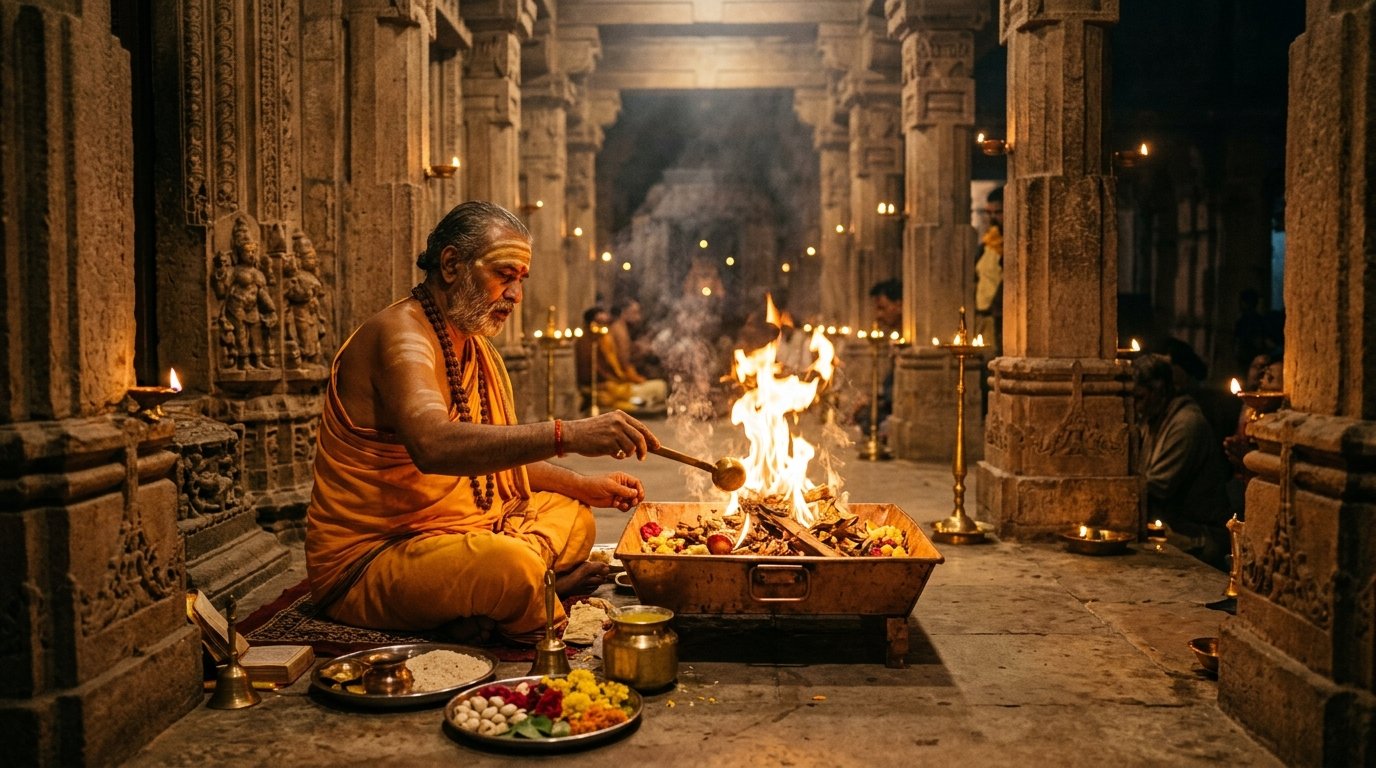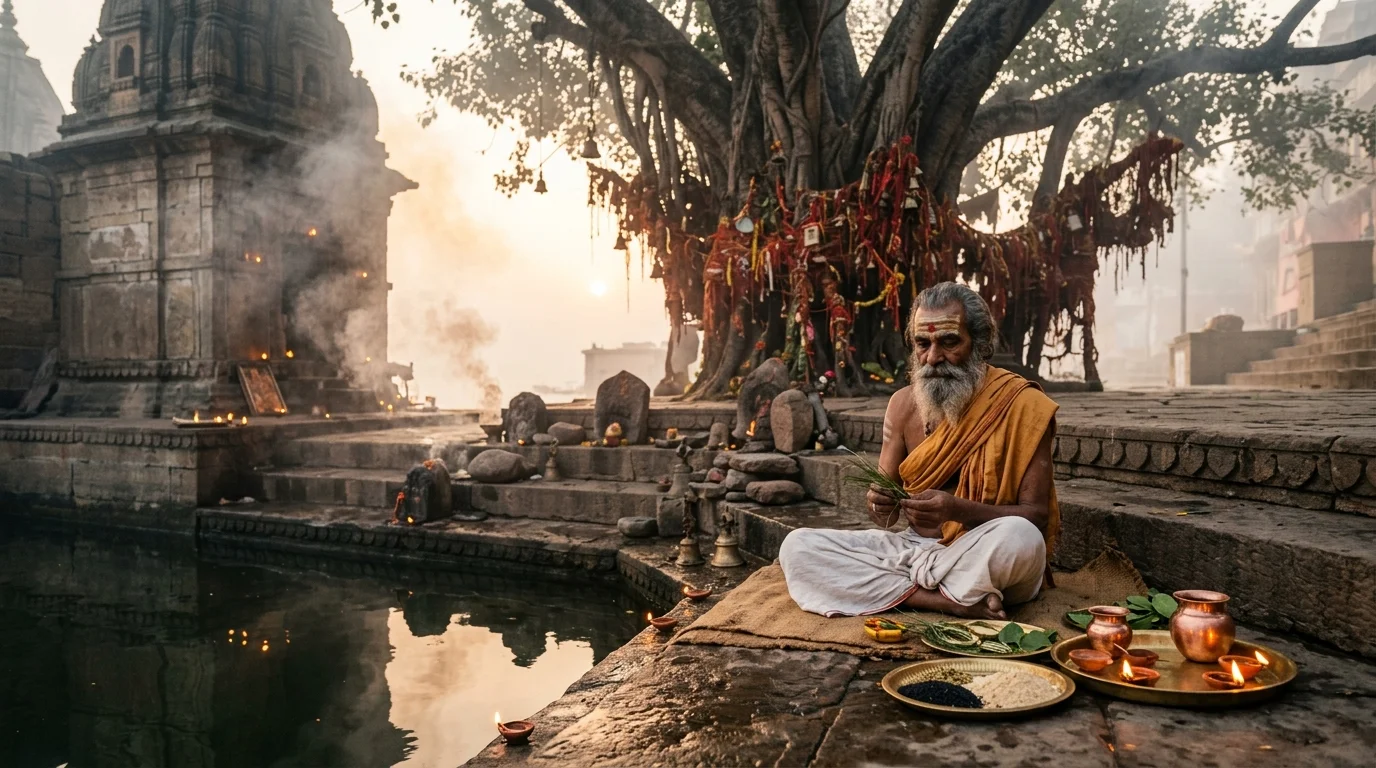
Pishach Mochan Kund in Varanasi, historically celebrated as Vimalodaka Teerth, is the supreme Vedic sanctuary for liberating ancestral souls trapped in Pretha Yoni (tormented disembodied states). Chronicled in the Kashi Khanda of the Skanda Purana and the Garuda Purana, bathing in these consecrated waters and offering Tripindi Shradh permanently severs severe generational Pitra Dosha. Under the eternal protection of Lord Shiva as Kapardeeshwar Mahadev, this ancient water body transforms restless spirits into benevolent, liberated ancestors.
When families experience unexplained domestic turbulence, recurring health afflictions, chronic financial stagnation, or repeated obstacles in childbirth, Vedic astrology traces the root cause to unappeased ancestral trauma. Ordinary annual Shradh rites conducted at home are often inadequate for souls who suffered premature or tragic deaths. In the sacred geography of Kashi, Pishach Mochan Kund operates as a divine court where karmic debts are formally discharged through authentic Pind Daan rituals.
Pishach Mochan Kund & Kapardeeshwar Mahadev Protocol
- Presiding Deity & Title: Kapardeeshwar Mahadev (The Lord of Matted Locks & Liberator of Wandering Souls), accompanied by the Trideva Murtis (Brahma, Vishnu, Mahesh).
- Exact Location & Access: Pishach Mochan Road, Chetganj, Varanasi (approx. 1.5 km west of Godowlia Crossing, near Lahurabir).
- Sanctum Hours & Muhurtas: Open daily 5:00 AM to 9:00 PM. Shradh rituals commence at Brahma Muhurta (6:00 AM – 11:30 AM) during Abhijit and Vijaya Muhurta.
- Sacred Offerings (Samagri): Kusha grass, black sesame (tila), barley flour (yava), unboiled milk, Ganga jal, white flowers, red cloth, and three unbaked clay diyas.
- Strict Sanctum Rules: No footwear within 10 meters of the kund steps. Men must wear an unstitched white cotton dhoti; strictly no leather belts, wallets, or shoes near the Peepal tree.
- Best Ritual Windows: Pitru Paksha (Bhadrapada Purnima to Sarva Pitru Amavasya), Margashirsha Shukla Chaturdashi, and any Krishna Paksha Amavasya.
Scriptural Origins: From Sage Kapardi’s Vimalodaka Teerth to Pishach Mochan
Long before this sacred pool acquired the name Pishach Mochan, it was revered across Aryavarta as Vimalodaka Teerth ("the pool of pure, sinless waters"). According to the Kashi Khanda of the Skanda Purana (Chapter 33), the great ascetic Kapardi Rishi performed severe tapasya on its northern banks for thousands of solar cycles. His intense devotion invoked Lord Shiva, who consecrated the waters with the power to obliterate even the darkest spiritual blemishes.
The waters of Vimalodaka Teerth were considered so spiritually radiant that even celestial beings descended from the heavens to perform ablutions. Kapardi Rishi established a consecrated Shiva Linga at the spot, known today as Kapardeeshwar Mahadev. The sacred spot became a sanctuary where seekers could wash away karmic impurities that defied standard penance.
The Legend of Kapardi Rishi and the Tormented Ghost (Pisacha)
The turning point in the teerth’s sacred destiny occurred when a terrifying, skeletal entity appeared before Sage Kapardi. This entity was a Brahmin named Shankhachuda who, due to treacherous sins, greed, and an unnatural death in a past life, was condemned to the wretched state of a Pisacha. Shivering with insatiable hunger and burning thirst, the spirit begged the compassionate sage for release from his agony.
Moved by boundless compassion, Kapardi Rishi consecrated the waters of the kund with sacred Vedic mantras and sprinkled them upon the trembling spirit. The sage then directed the spirit to immerse itself into the holy waters while chanting the glory of Lord Shiva. The moment the holy water touched the ghost's incorporeal form, centuries of torment dissolved instantly.
The spirit shed its deformed, ghostly visage and emerged in a luminous, celestial body (Divya Sharira) adorned with heavenly garlands. Lord Shiva appeared before them and proclaimed: "Because this teerth has liberated a Pisacha from eternal torment, it shall forever be celebrated throughout the three worlds as Pishach Mochan Teerth." Mahadev declared that anyone offering tarpana here would secure instant liberation for their departed kin.
"विमलोदकतीर्थे तु स्नात्वा यः कुरुते नरः। श्राद्धं पिण्डप्रदानं च सर्वपापैः प्रमुच्यते॥"
— Skanda Purana, Kashi Khanda: "A person who bathes in Vimalodaka Teerth (Pishach Mochan) and performs Shradh and Pind Daan becomes fully liberated from all hereditary afflictions and spiritual debts."
Garuda Purana Citations: Understanding Pretha Yoni and Ancestral Unrest
In the Pretha Khanda of the Garuda Purana, Lord Vishnu explains to Garuda the horrifying reality of Pretha Yoni. When an individual dies an untimely or unnatural death (Durmarana)—such as from accidents, poison, violent crime, or sudden fatal illness—the subtle astral body fails to cross the Vaitarani river. Lacking a physical body to exhaust desires yet retaining earthly attachments, the soul suffers intense hunger and thirst without the ability to consume physical matter.
These trapped souls often remain suspended in the earth's subtle atmospheric sphere, desperately attempting to draw attention from living descendants. This energetic blockage manifests in families as Pretha Badha or severe Pitra Dosha. Standard annual Shradh rituals cannot reach souls stuck in this lower realm because they require specialized tripartite purification.
The Triple Form of Tripindi Shradh: Satvik, Rajasik, and Tamasik Prethas
The Garuda Purana explicitly prescribes that souls trapped in ghostly bondage require pacification through three distinct cosmic energies. The Shastras categorize ancestral unrest into three energetic states: Satvik Pretha (desiring spiritual advancement), Rajasik Pretha (bound by unfulfilled material desires), and Tamasik Pretha (trapped in anger, sudden trauma, or violent death). To address all three, our verified Kashi Purohits perform the comprehensive Tripindi Shradh at Pishach Mochan.
During this ritual, three distinct pindas are prepared using specific grains and elements to satisfy each cosmic aspect. Lord Brahma is invoked with barley flour for Satvik ancestors, Lord Vishnu with black sesame and rice flour for Rajasik ancestors, and Lord Rudra with black gram (urad) flour for Tamasik ancestors. This threefold offering dissolves the astral knot (Granthi), liberating the trapped soul into higher spiritual realms.
The Sacred Peepal Tree: The Living Anchor of Spirit Release
At the southern ghat of Pishach Mochan Kund stands a colossal, ancient Peepal (Ashvattha) Tree that has stood witness to thousands of years of liberation rites. In Vedic theology, the Peepal tree represents the cosmic pillars of creation, preservation, and dissolution. It is at the roots of this sacred tree that pilgrims perform the critical Ganda Bandhana and release rituals.
Traditionally, when a soul is identified as restless, the priests bind a sacred sanctified thread (Raksha Sutra) to an iron nail driven into the bark, symbolizing the tethering of the erratic spirit to the divine altar. Upon completion of the Vedic mantras and pinda offerings, the priest performs the final Visarjan, cutting the symbolic thread and releasing the spirit into the supreme grace of Lord Shiva. Devotees then light unbaked clay lamps filled with mustard oil beneath the tree to illuminate the soul's upward journey.
Realistic Ritual Logistics, Timings & Genuine Dakshina Benchmarks
Navigating ancestral rituals in Varanasi requires transparency so devotees can plan their pilgrimage with absolute peace of mind. Below is our verified, ground-tested breakdown of ritual formats, auspicious timings, necessary samagri, and authentic dakshina guidelines for rituals at Pishach Mochan Kund.
Hyper-Local Navigation: How to Reach Pishach Mochan Without Getting Lost
Pishach Mochan Kund is nestled in the historic Chetganj quarter of Varanasi, slightly inland from the main Ganga ghats. If you are staying near Dashashwamedh Ghat or Godowlia Crossing, auto-rickshaws cannot travel directly through the tight alleys. Take a battery e-rickshaw or walk toward Lahurabir via Ramkatora; the journey is roughly 1.5 kilometers and takes 10 minutes.
For pilgrims arriving directly from Varanasi Junction (BSB Cantt) railway station, the distance is merely 2.5 kilometers. Instruct the auto-rickshaw driver to drop you directly at the Pishach Mochan Chauraha entrance arch. From the arch, a paved 100-meter walkway leads straight down to the stone ghats and the ancient shrine of Kapardeeshwar Mahadev.
Devotee Advisory: Avoiding Exploitation & Fake Panda Traps
Because ancestral rituals carry deep emotional vulnerability, unscrupulous touts frequently target grieving families around transit hubs. As dedicated stewards of Varanasi's Vedic heritage, our mission is to ensure every devotee experiences a dignified, shastric, and transparent ritual. Keep these ground-tested rules in mind:
- Beware of Auto-Rickshaw "Family Panda" Scams: Drivers near Varanasi Cantt station often claim their "personal family priest" holds the official hereditary register for your ancestral gotra at Pishach Mochan. Always decline and insist on meeting verified priests or heading directly to your pre-booked sanctuary.
- Reject Fear-Based Extortion: Fake pandas often scrutinize a devotee’s palm or family horoscope to manufacture terror, claiming a "wrathful ghost will destroy your family" unless you hand over ₹15,000 to ₹25,000 immediately. Genuine Shastric rituals are solemn, peaceful acts of dharmic duty, never high-pressure financial extractions.
- Pre-Agree on Dakshina Before Commencing Sankalpa: Before holding the sacred kusha grass and water in your palm for the initial sankalpa, confirm that the agreed dakshina covers all samagri, Brahmin dakshina, and temple maintenance. Never allow unvetted handlers to introduce surprise costs halfway through the ceremony.
- Demand Proper Gotra and Pravara Recitation: An authentic Tripindi Shradh requires accurate recitation of your three maternal and paternal ancestral generations. If a priest rushes through generic slokas without noting your Gotra, Nakshatra, and deceased ancestors' names, the ritual lacks Shastric potency.
Frequently Asked Questions
Why is Pishach Mochan Kund chosen over Gaya for Tripindi Shradh?
While Gaya is the ultimate destination for universal ancestral salvation (Pind Daan for Pitru Loka), the Garuda Purana reserves Pishach Mochan in Kashi specifically for souls stuck in Pretha Yoni (untimely deaths, suicides, or demonic states). Kapardeeshwar Mahadev holds the divine authority to break the restless astral binding, making Kashi the irreplaceable first step before proceeding to Gaya.
Can family members perform Tripindi Shradh at Pishach Mochan remotely?
Yes, the Shastras permit Pratinidhi Sankalpa when physical travel to Varanasi is prevented by illness, age, or international borders. A qualified Kashi Teerth Purohit takes your exact Gotra, Nakshatra, and ancestral names at the kund steps during Brahma Muhurta, broadcasting the live ceremony so you can participate from home.
What is the difference between normal Pind Daan and Tripindi Shradh?
Normal Pind Daan feeds ancestors who have already attained Pitru Loka and awaits annual nourishment during Pitru Paksha. Tripindi Shradh is an emergency tripartite ritual utilizing three distinct grain offerings (Brahma, Vishnu, and Rudra) to rescue souls detained in the intermediate ghost realm due to unresolved karmas.
What should devotees wear during rituals at Pishach Mochan?
Men performing the rites must wear an unstitched, clean white cotton dhoti and an angavastram draped over the left shoulder (Savya position transitioning to Apasavya). Women should wear modest yellow, saffron, or white sarees; synthetic clothes and any leather items (belts, wallets, footwear) are strictly prohibited inside the ritual perimeter.
How long does a complete Tripindi Shradh ritual take at the kund?
A rigorous, Shastrically complete Tripindi Shradh conducted by authorized Vedic priests requires between two to two and a half hours. This includes the initial purification bath, Gotra sankalpa, Tila tarpana, preparation and offering of the three sacred pindas, the sacred Peepal tree ritual, and the final Kapardeeshwar Abhishek.