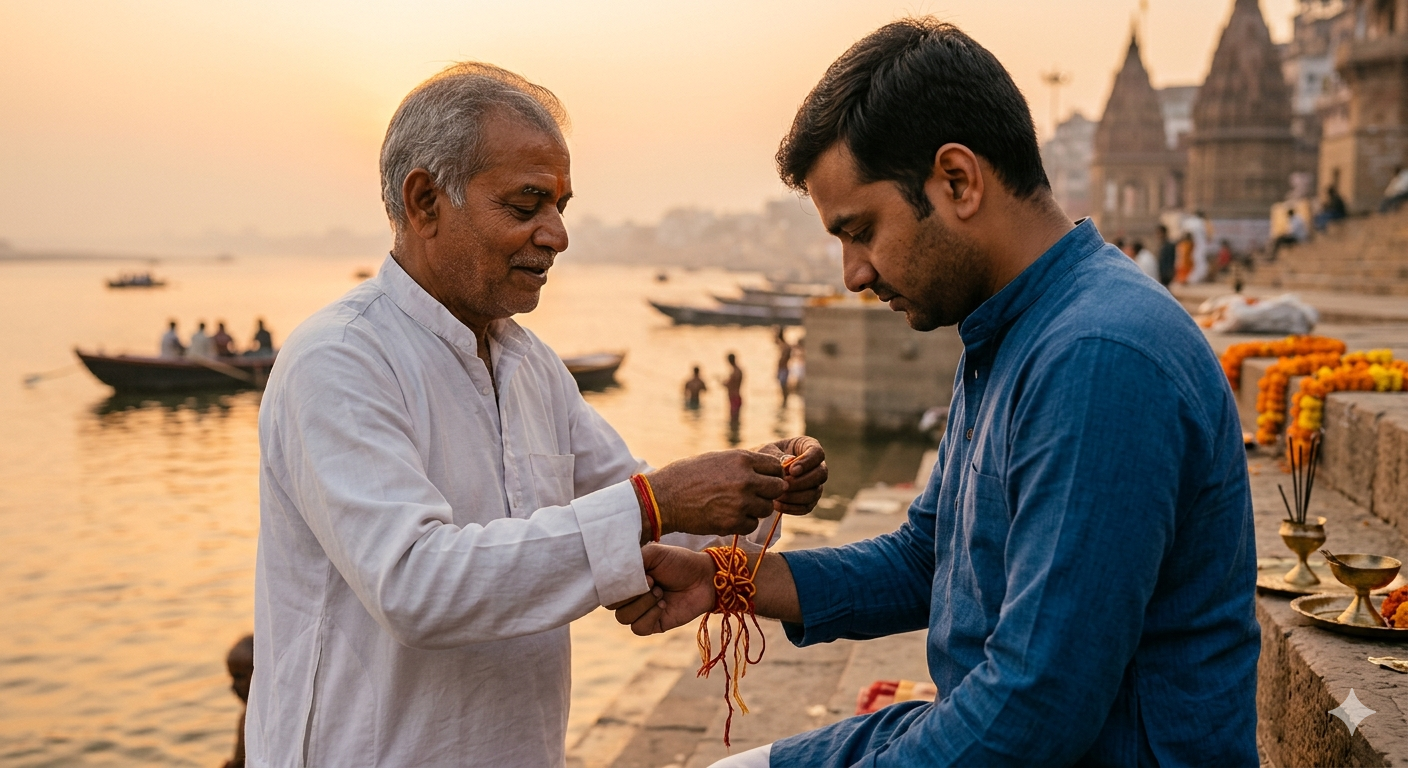
The scent of burning camphor lingers in the air as the morning sun glistens off the ripples of the Ganga at Dashashwamedh Ghat. You sit before a Vedic Acharya, the rhythmic vibration of Sanskrit mantras grounding your soul. As the ritual concludes, he takes a strand of crimson-and-yellow thread—the Mauli—and binds it around your wrist.
In that moment, you aren't just wearing a string; you are being woven into a lineage of protection that spans millennia. But what is the deeper significance of this "Kalava"? Is it merely a cultural marker, or is there a profound metaphysical science behind this sacred thread?
The Vedic Origins: Why We Tie the Kalava
The Mauli, also known as Kalava or Charadu, finds its roots in the ancient Shastras. The word "Mauli" literally translates to "crown" or "above all," often referencing Chandra-Mauli, the one who wears the moon as a crown (Lord Shiva).
According to the Bhavishya Purana, the practice was solidified during the Vamana Avatar of Lord Vishnu. When King Bali was being sent to the underworld, Lord Vishnu tied a sacred thread on his wrist to grant him immortality and protection.
“Yena baddho Balee raajaa daanavendro mahaabalah | tenatwaam abhibadhnaami rakshe maachal maachal ||”
Translation: “I am tying on you the same thread that bound the mighty King Bali. O Protector, do not move, do not leave.”
By tying the Mauli, the devotee invokes the protection of the Trinity (Brahma, Vishnu, Mahesh) and the three primordial Shaktis (Saraswati, Lakshmi, Durga).
The Science of Subtle Energy: A Biological Perspective
While the spiritual significance is paramount, the Vedic sages were master scientists of the human anatomy. The placement of the Mauli is not accidental; it is tied specifically on the wrist—the site of the Manibandha.
1. Regulation of Tridoshas
According to Ayurveda, the wrist is a junction point where the three Nadis (energy channels) corresponding to Vata, Pitta, and Kapha can be accessed. Constant, gentle pressure from the Mauli acts as a form of non-invasive acupressure. It is believed to help regulate blood circulation and balance these three humors, ensuring the body remains resilient against seasonal ailments.
2. The Nerve Connection
Modern anatomy identifies several key nerves passing through the wrist. Ancient texts suggest that the "knotting" of the thread creates a subtle bio-magnetic field. This field acts as a shield, preventing the leakage of Prana (life force) from the body during spiritual practices.
3. Psychological Anchoring
In SEO terms, we might call this "Intentional Branding." Spiritually, every time you glance at the vibrant red thread on your wrist, it acts as a Sankalpa (vow) reminder. It tethers the wearer to their spiritual commitments, acting as a psychological guard against "Adharma" or unethical actions.
The Ritual Vidhi: How it is Tied in Kashi
In the sacred geography of Varanasi, the procedure for tying the Mauli follows strict Agamic traditions.
- The Hand: Men and unmarried women have the thread tied on the Right hand, representing the active, solar energy (Pingala). Married women have it tied on the Left hand, representing the receptive, lunar energy (Ida).
- The Circles: The thread is traditionally wrapped three times around the wrist. This symbolizes the three gunas (Sattva, Rajas, Tamas) and the three states of consciousness (Waking, Dreaming, Deep Sleep).
- The Fist: The wearer is asked to keep their fist closed and their hand over their head. This posture signifies the gathering of energy and the acceptance of divine grace from the Sahasrara (Crown) Chakra.
Components of the Thread: Material and Symbolism
- Cotton (Sutra): The use of pure cotton signifies purity and the ability to absorb Vedic vibrations during the chanting of mantras.
- Red (Rakshasa): Symbolizes bravery, power, and the energy of Goddess Durga.
- Yellow/Orange: Symbolizes spiritual wisdom, peace, and the benevolence of Lord Vishnu.
Remote Sankalpa: Bridging Kashi and the Global Diaspora
For our NRI community in the USA, UK, or Australia, being physically present at the Manikarnika or Assi Ghat isn't always possible. However, the Vedic Science of Sound transcends physical distance.
Through a Remote Sankalpa via Video Call, our Kashi-based Acharyas perform the Puja in your name. While the priest ties the Mauli on a symbolic representation or holds it over the holy Ganga, the energy is transferred through the "Prana Pratishtha" of the mantra. We then ship the Abhimantrit (consecrated) Mauli and Prasad globally, ensuring that you wear a thread that has truly "breathed" the air of Kashi.
Frequently Asked Questions (FAQ)
1. How long should I wear the Mauli thread? The Mauli should ideally be worn for at least 21 days or until the next major ritual. If it becomes frayed or dirty, it should be removed respectfully and immersed in a natural water body or buried under a tree, rather than thrown in the trash.
2. Can I tie the Mauli myself? While you can, the ritual potency is highest when tied by an elder, a Guru, or a Brahmin priest while chanting the Raksha Mantra. This facilitates a transfer of blessings and protection from the initiator to the wearer.
3. What is the difference between Red and Yellow Mauli? Red is typically associated with Shakti (power) and protection from enemies, while yellow is associated with Brihaspati (Jupiter) and signifies knowledge, prosperity, and mental peace. Many threads use a combination of both for balanced energy.
4. Does the Mauli have any health benefits? According to Ayurveda, the gentle pressure on the wrist's pulse points helps balance the Vata, Pitta, and Kapha doshas. It is believed to aid in regulating blood pressure and improving the body’s overall energetic stability.
5. Why is the Mauli wrapped three times? The three wraps symbolize the Holy Trinity (Brahma, Vishnu, Shiva) and serve as a reminder of one’s debt to the gods, ancestors, and the sages (Deva Rin, Pitru Rin, and Rishi Rin).
6. Can non-Hindus wear a Mauli? Yes. The Mauli is a "Raksha Sutra" (Protection Thread). It is a universal symbol of seeking divine protection and can be worn by anyone who respects the Vedic tradition and its spiritual significance.