The air in Varanasi carries a weight that is both ancient and ethereal. As the pre-dawn mist rises from the Ganga, the rhythmic clanging of temple bells merges with the deep, guttural resonance of Vedic chanting. For the uninitiated, a Puja might look like a series of symbolic gestures with incense and flowers. However, to the Vedic scholar and the devoted seeker, it is a sophisticated spiritual technology designed to bridge the gap between the mundane and the Divine.
In the heart of Kashi, we do not merely "perform" a ritual; we invoke a cosmic presence. This guide explores the Shodashopachara Puja—the 16-step foundational ritual that serves as the gold standard for authentic Hindu worship.
The Spiritual "Why": Why 16 Steps?
In our modern, fast-paced lives, we often feel a sense of spiritual "static"—a disconnect from our source that manifests as anxiety, familial discord, or a lack of purpose. The Shodashopachara Puja is the antidote.
The number 16 is significant in Vedic cosmology; it represents the 16 Kalas (phases or attributes) of the moon and the 16 types of energy that govern the human experience. By following this sequence, the seeker moves from the physical world to the deep state of Samadhi (meditation).
“Pujayeat Devam Atmanam, Na Devo Devam Archayeat.” (Worship the Divine by becoming Divine; a non-divine being cannot worship the Divine.) — Gandharva Tantra
The Step-by-Step Vidhi: The Journey of Invitation
1. Avahana (Invocation)
We begin by inviting the deity into the Murti or Kalash. In Kashi, this is done with a "Sankalpa," a solemn vow that connects your specific lineage and location to the cosmic time-cycle.
2. Asana (Seating)
Just as you would offer a chair to an honored guest, we offer the deity a seat. Symbolically, this represents providing a stable place for the Divine energy to reside within our own hearts.
3. Padya (Washing of Feet)
In the dusty terrains of ancient India, washing the feet of a guest was the first act of hospitality. Spiritually, this washes away the "dust" of worldly attachments.
4. Arghya (Offering Water)
Water is offered to the hands for purification. It signifies the cooling of the "Taapa" (sufferings) of the material world.
5. Achamana (Sipping Water)
The practitioner sips water to purify the internal speech and throat. It is the preparation for chanting the sacred Beeja Mantras.
6. Snana (The Holy Bath)
The deity is bathed in Panchamruta (milk, curd, ghee, honey, and sugar). In Kashi, we use the life-giving waters of the Ganga, believed to be the liquid form of Shakti.
7. Vastra (Offering Garments)
Offering cloth signifies the protection of the soul. It represents the "covering" of the ego to reveal the inner self.
8. Yajnopavita (The Sacred Thread)
The offering of the Janeu symbolizes the commitment to knowledge and the three debts: to the Gods, the Sages, and the Ancestors.
9. Gandha (Sandalwood Paste)
Sandalwood provides a cooling effect. In terms of spiritual science, applying Chandan to the "Ajna Chakra" (third eye) helps in stabilizing the mind during the ritual.
10. Pushpa (Offering Flowers)
Each flower carries a specific vibration. In Shiva-dham (Kashi), the Bilva leaf and Dhatura are essential, representing the destruction of the three Gunas (qualities) of the ego.
11. Dhupa (Incense)
The smoke of the incense symbolizes the burning of latent desires (Vasanas). As the smoke rises, so should our consciousness.
12. Deepa (The Lamp)
The light of the ghee lamp represents Jnana (knowledge). It is the dispelling of Avidya (ignorance).
13. Naivedya (Food Offering)
We offer the best of our harvest. This step teaches us that everything we consume is actually a gift from the Divine.
14. Tambula (Betel Leaf & Nuts)
A traditional digestive aid, this represents the "completion" of the meal and the refinement of the senses.
15. Niranjana (Aarati)
The final waving of lights. As the camphor burns without leaving a residue, the devotee prays that their ego may also dissolve completely into the Divine light.
16. Pushpanjali & Pradakshina (Final Salutation)
We offer flowers as a final token of love and circumambulate the deity, acknowledging that the Divine is the center of our universe.
The Science of Ritual: Beyond Symbolism
Why do we use Kusha Grass or Black Sesame?
- Kusha Grass: Scientifically known for its conductive properties, it acts as an insulator, ensuring the energy generated during Mantra chanting is grounded within the practitioner’s body.
- Akshata (Unbroken Rice): Represents "Akshaya" or that which never decays. It is a potent carrier of vibrational energy.
Global Devotion: The Kashi Edge for NRIs
For those living in London, New York, or Sydney, performing a full Shodashopachara can be daunting due to the lack of authentic materials or trained Acharyas.
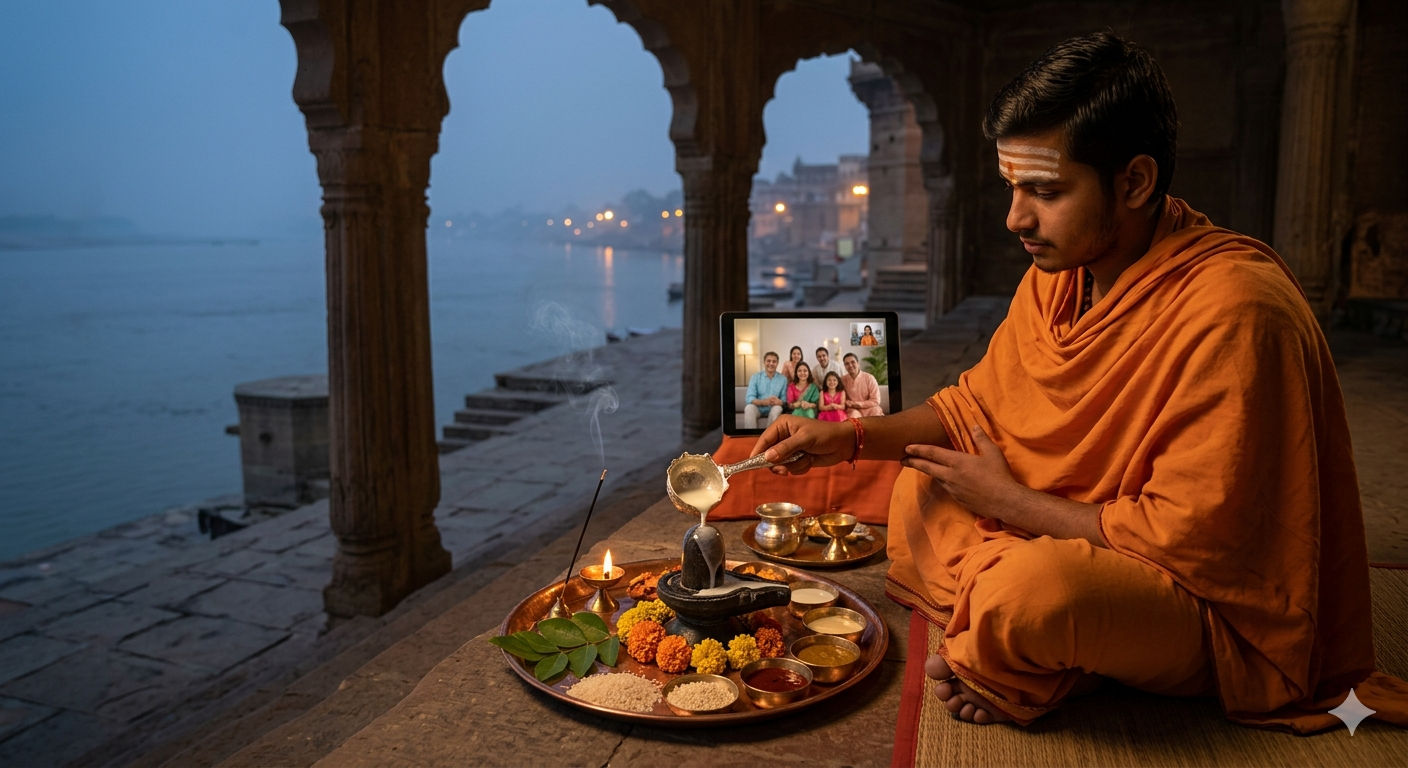
At SacredKashi, we bridge this gap through Remote Sankalpa.
- Live Streamed Rituals: You participate via video call while our English-speaking Pundits perform the ritual on the banks of the Ganga.
- Digital Presence: Your name and Gotra are invoked at the start, ensuring the karmic benefits reach you across borders.
- Prasad Delivery: We use specialized vacuum packaging to ensure the Bhasma or Prasad reaches your international doorstep within days.
Frequently Asked Questions (FAQ)
1. What is the significance of Shodashopachara Puja? It is a 16-step Vedic ritual that treats the deity as an honored guest, systematically purifying the environment and the practitioner's mind to invite Divine presence and blessings.
2. Can Shodashopachara be performed at home? Yes, it can be performed at home. However, performing it in a Siddha Peeth like Kashi amplifies the spiritual vibrations and ensures adherence to strict Vedic injunctions.
3. Do I need to know Sanskrit to benefit from the Puja? While the Mantras are in Sanskrit, the benefit lies in the vibration and your intention (Bhava). Our Acharyas provide English explanations to ensure you are mentally aligned with the ritual.
4. How long does a full 16-step Puja take? An authentic Shodashopachara Puja typically takes between 45 to 90 minutes, depending on the complexity of the deity’s specific Vedic hymns (Sukhtams).
5. What is the role of the 'Sankalpa' in a remote Puja? The Sankalpa is a formal declaration of intent. Even if you are physically distant, the mention of your name, location, and lineage connects you energetically to the ritual's fruits.
6. Is it necessary to use Ganga water for the ritual? In Vedic tradition, Ganga water is considered Amrit (nectar) and is self-purifying. Using it for steps like Snana and Arghya significantly enhances the ritual’s potency.